
INDARB Cohort 1
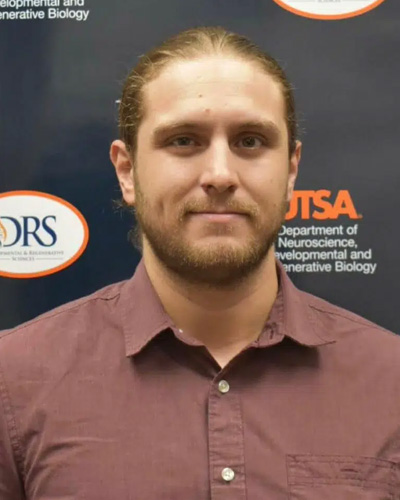
Jake Gray
DRS PhD, 4th year
Mentor: Dr. Brian Hermann
Co-Mentor: Dr. Jenny Hsieh
Research: Stem cells help our tissues grow, repair damage, and adapt to disease, but how they decide what to become—and when—remains an open question. Through this INDARB T32-supported project, I study how stem and progenitor cells respond to their environment using a shared genetic toolkit across two very different organs: the testis and the brain. By tracking cells that express the gene Sox3, my work asks whether certain progenitor cells can step in as backup stem cells during tissue repair and whether similar cells in the brain contribute to abnormal support cells that arise during epilepsy. Together, these studies aim to reveal common principles of cell flexibility that may ultimately inform regenerative medicine and neurological disease research.
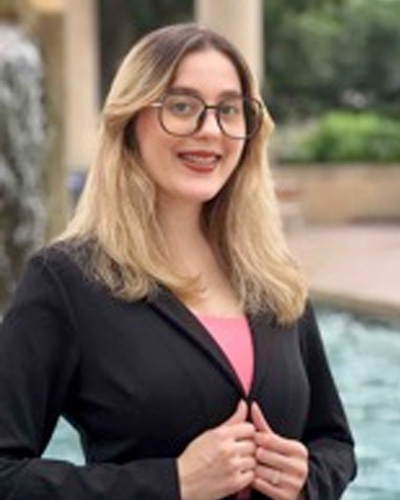
Kelly Lozano Ortiz
Neuroscience PhD, 4th year
Mentor: Dr. Anthony Burgos-Robles
Co-Mentor: Dr. Jenny Hsieh
Research: Through this INDARB T32–supported project, my research looks at how the brain remembers social threats—experiences that can cause long-lasting changes in behavior, such as avoiding others long after the danger has passed. Using a mouse model, I study how the prefrontal cortex, a brain region involved in decision-making and social behavior, changes after stressful social experiences. I am especially interested in whether the brain generates new cells in this region following social trauma, and whether these new cells help reinforce long-term fear and avoidance. By understanding how social stress reshapes the brain, this work may help explain why social trauma can have lasting effects on behavior and mental health.
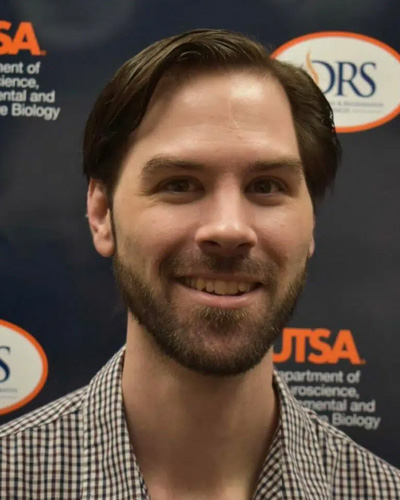
Kyle Pressley
DRS PhD, 4th year
Mentor: Dr. Thomas Forsthuber
Co-Mentor: Dr. Matt Wanat
Research: Cocaine has no FDA approved treatment and disrupts immune signaling in the brain, particularly in a reward related region called the ventral tegmental area (VTA). Through this INDARB T32-supported project, I study how brain inflammation influences cocaine related behaviors, with the goal of identifying new strategies to reduce drug use and relapse. My research focuses on a specific immune signaling pathway involving the molecule TNF-α and one of its receptors, TNFR2, which is thought to protect brain cells and limit harmful inflammation. By using genetically engineered mouse models, this work aims to clarify how beneficial immune signaling in the brain can counteract cocaine's effects and inform future therapeutic approaches for substance use disorders
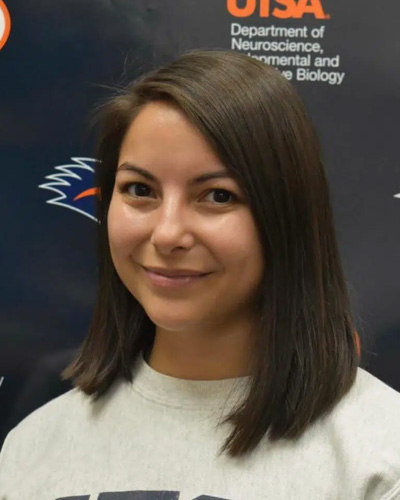
Stephanie Villalon
DRS PhD, 4th year
Mentor: Dr. John McCarrey
Co-Mentor: Dr. Anthony Burgos-Robles
Research: Through this INDARB T32-supported project, I study how social isolation stress affects learning by altering gene regulation in the brain. Focusing on the medial prefrontal cortex—a region critical for decision-making and stress responses—I examine how social isolation changes neural activity and gene expression in two closely related but functionally distinct subregions. Building on prior work showing that these subregions play opposing roles in stress-related learning, my research seeks to uncover how stress reshapes the molecular and epigenetic programs of neurons to impair learning. This work aims to reveal how social stress "gets under the skin" to produce lasting changes in brain function and behavior.
INDARB-2
INDARB-2 Cohort 1
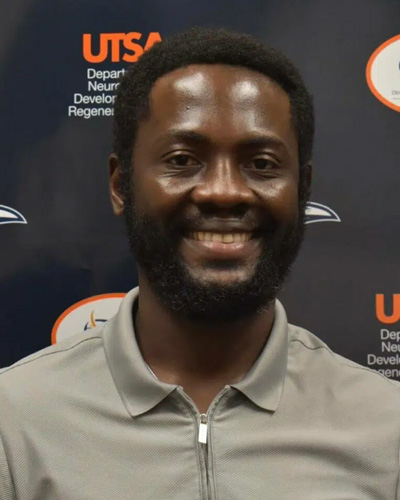
Adebayo Adeyeye
DRS PhD, 4th year
Mentor: Dr. Jenny Hsieh
Research: I study how new brain cells are generated in the adult hippocampus after traumatic brain injury and how they may contribute to the development of epilepsy. While this process is intended to repair damaged brain tissue, some newly formed cells become abnormal and disrupt normal brain function. My research aims to identify and selectively target these harmful cells to reduce seizures while preserving healthy brain repair. This work may help guide new treatments for traumatic brain injury and post-traumatic epilepsy.
Brandon Garcia
Neuroscience PhD, 3rd year
Mentor: Dr. Matt Wanat
Research: My research focuses on understanding how astrocytes interact with neurons to shape rodent behavior. In particular, I study astrocytes in the ventral tegmental area (VTA), a midbrain region that is part of the mesolimbic dopamine system and remains understudied in this context. Using viral approaches, I record astrocyte activity, suppress calcium signaling, or chemogenetically increase calcium levels to determine how these manipulations influence dopamine release in the nucleus accumbens. I additionally examine how these circuit-level changes affect drug reward, food reward, and active avoidance learning in rats. This work aims to clarify the role of astrocytes in motivated behaviors and has the potential to inform future astrocyte-targeted therapeutic strategies.

Sara Mirsadeghi
Neuroscience PhD, 3rd year
Mentor: Dr. Jenny Hsieh
Research: My project aims to uncover the mechanisms underlying neural network hyperexcitability in patients with ARX mutations, who present with intellectual disability and epilepsy from birth. I use brain organoids to recapitulate cortical neural network development in vitro, combined with next-generation 3D multi-electrode arrays to record network activity from both control organoids and those derived from patients. My preliminary results indicate that cortical neural networks in patient-derived organoids develop a hyperexcitable, hypersynchronous, and hyperbursting phenotype. Building on these findings, I am now investigating the underlying mechanism, specifically testing whether this phenotype arises from interneuronopathy within the developing network. In parallel, I plan to screen candidate compounds for their ability to rescue the hyperexcitability phenotype, with the long-term goal of identifying therapeutic avenues for patients with ARX-related disorders.
