
Thank you for your interest in the RISE Undergraduate program. After 45 years, and hundreds of undergraduates trained and launched into amazing scientific careers as doctoral level scientists, the RISE program has ended. We celebrate our students and their accomplishments and will continue to seek out ways to support the highly talented and dedicated future scientists at UT San Antonio.
Undergraduate level RISE students participated in diverse activities designed to assist them toward successful careers in the research sciences. One of the most significant was participation in laboratory research.
All RISE Undergraduate students performed laboratory research on the main campus, part time during the Fall and Spring semester (15 hours/week), and full time (40 hours/week) during the summer when they were not at a summer research program. Students worked in the laboratory of a faculty member who served as their faculty mentor. Students were expected to stay in this laboratory until they graduated unless circumstances dictate otherwise.
Why Students Perform Research
Students perform research:
- To gain valuable experience
- Because it's required for PhD program admission
- To obtain letters of recommendation
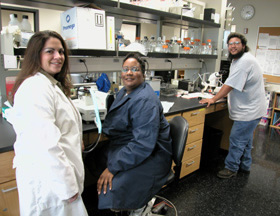
Do not underestimate the importance of the letter of recommendation that you will obtain from your laboratory mentor. You can get all the experience in the world on a variety of techniques, but if the letter from your mentor is weak, you are probably not going to get into a good graduate program. Really. As a result, it's important to make a strong positive impression while you are in the lab. For an optimum letter, you want to show them that you have the following characteristics: Excitement about research, hard work, teachable, learns from mistakes, resilient when making mistakes, critical thinking (ideas about your project and what it means!), willingness to dig into the literature, curiosity, problem solving, thinking about experimental design, reasonably mature, responsible (show up when you say that you will!), and able to work well with others. If you do not have all of these characteristics, that's okay... just don't come off as lazy or uninterested!
How to Find a Faculty Mentor
The RISE program had a list of approved mentors from whom students should choose. If a new RISE student was already in a laboratory, they were generally allowed to continue in that lab, but the mentor had to submit a RISE Mentor application that was reviewed by the RISE Administrative Committee. If a new RISE student did NOT have a mentor on entry, the student reviewed the list of mentors and selected approximately five (5) to show to Dr. Taylor. She advised the student on mentor choice and provided advice regarding how to approach these researchers. Students were advised, minimally, to pre-read at least one of the mentor's scientific papers and to create a minimal CV prior to interviewing. Students were advised that once in the lab, they would likely be working with (and even trained by) someone other than their mentor, but it's still the mentor's lab!
Safety Classes
All students had to complete the following training courses prior to beginning work in any lab:
- Hazard Communication/Lab Safety — SA 443
- Hazardous Waste Generator — SA 401
Biology labs required additional training:
- Bloodborne Pathogens — SA 419
- Biosafety — SA 467
For labs that use radioactive materials and/or lasers, the following training was also required:
- Laser Safety Awareness — SA 453
- Laser User — SA 465
- Radiation Safety — SA 433
Most of these courses were offered online at https://mytraining.utsa.edu/online/. They were also offered monthly in a classroom style setting on West Campus.
In the Lab
Once in the laboratory, remember that you are now a "member" of that lab. You might shadow someone and learn techniques at the beginning. Quickly read any papers that the mentor provides to you to read and be prepared to answer questions about them! (note: it might take you a couple of hours to read one paper). Make every effort to attend laboratory meetings; these are extremely important for your development and demonstrate your commitment to the lab. You may also receive a laboratory "job" that you will perform to assist with laboratory maintenance. Very soon, you should begin to perform experiments, hopefully on your own research project. As you prove yourself more and more, you will likely be given greater responsibility in the lab. Remember...you need to clean up your own mess and complete your own experiments!
The first year that you are in the lab, you are expected to submit an abstract to the ABRCMS or SACNAS conferences. You will work with your mentor to complete a summary of your research and send it in before the deadline. You will also register for the conference (the program will pay). Before the conference, you will create a poster or oral presentation that you will give at the conference. In subsequent years, you will attend a major scientific conference with your research mentor (again, the program will pay).
Hopefully, over time, you will complete sufficient research that your work will be submitted as part of a scientific paper. It's great to be anywhere in the list of authors; it's best to be first author, but this means that you were also the primary person performing the research.
