Thank you for your interest in the RISE Undergraduate program. After 45 years, and hundreds of undergraduates trained and launched into amazing scientific careers as doctoral level scientists, the RISE program has ended. We celebrate our students and their accomplishments and will continue to seek out ways to support the highly talented and dedicated future scientists at UT San Antonio.
Undergraduate level RISE students participated in diverse activities designed to assist them towards successful careers in the research sciences. In the process, they:
- Developed the credentials and experience needed for doctoral program success
- Built professional skills needed during graduate school and beyond
- Learned about the various fields and career paths that they can pursue
- Networked with scientists from around the country and learned about opportunities
RISE UG Laboratory Research
Of primary importance to the RISE programs was the hands-on laboratory research experience in a University of Texas at San Antonio or UT Health San Antonio laboratory. Students worked in the laboratory, preferably on their own research projects, the complexity of which depended on student level and experience. They were responsible for this project and progressed from learning techniques to having intimate knowledge and understanding of the science and ideas underlying their work. In the process, they developed a relationship with a research mentor would be instrumental in writing recommendation letter needed for graduate school admission or beyond. Students were integral members of the laboratory, participating in laboratory meetings and performing routine laboratory responsibilities as assigned by their mentor.
RISE Technology Laboratory and Classroom (Tech Lab)
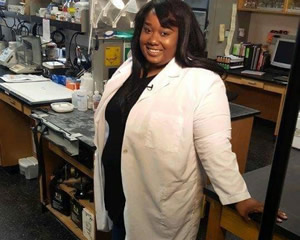
RISE participants also took various classes, generally held in the RISE Communication Technology Laboratory and Classroom (Tech Lab). RISE, MARC, and other student and faculty researchers have free access to this laboratory, where they can work not only on their projects, but also on any schoolwork that they need to get done. We encouraged students to use these facilities for study groups and to create and practice any presentations that they may have to give. By doing so, they also gained experience in the use of state-of-the-art presentation and instructional equipment.
RISE UG Program Sponsored Training Courses
Coursework
All trainees took:
- Biology I or Biosciences for non-majors
- Two semesters of Honors Research credit (similar to Independent Study) in their major (6 credits total): BIO 4993, CHEM 4993, CS 4993, EGR 4993 (for BME unless BME 4993 is developed), MAT 4993, PHY 4993, PSY 4993, or STA 4993
- BIO 4953: Research Careers and Professional Skills Development (1 semester of a 3-credit course; counts as upper division Biology elective)
- University Sponsored Responsible Conduct in Research, Laboratory Safety, and Compliance activities
In addition, all trainees completed:
- Statistics or equivalent
- Upper division courses pertinent to the focus of their laboratory (Biophysics, Biochem, etc.)
We believe that these additional courses enhance student preparation for doctoral programs in the biological, chemical, or biologically-oriented computational sciences, without creating an overwhelming burden on students who are already carrying a heavy course load. Most, if not all, of these courses counted towards the individual student's degree program.
Thesis
All students were required to complete a Departmental Honors with a thesis. This involved the creation of a manuscript that described the student's research project. The format was identical to that of an Honors Thesis and could also be used for College of Sciences Distinction in Research. Receipt of the final stipend check was conditional on submission of the thesis.
RISE Seminar and Lunch with the Speaker
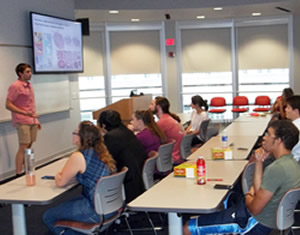
Four times each semester, all RISE students attended a scientific seminar given by a role model scientist or scientist with a background in ground-breaking academic research, government research, or industry. Following the seminar, students met for lunch with the seminar speaker, providing networking opportunities as well as a chance to interact with other RISE and MARC students.
National and Local Conferences
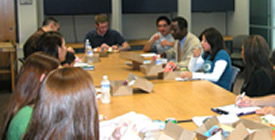
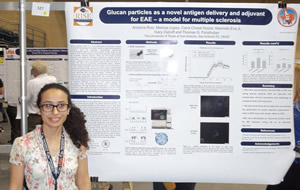
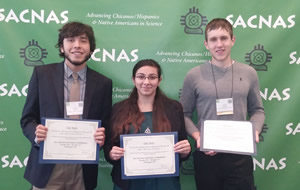
One of the more exciting activities in which our students participated was the attendance of national scientific conferences. Undergraduates first attended the SACNAS or ABRCMS conferences. These two conferences focus on scientific development and feature poster and oral presentations, professional development activities, and advertisement of various graduate and summer program options by schools from throughout the country. Subsequently, undergraduates may have chosen to attend national professional scientific conferences with their mentors and lab mates. Students may also have participated in various local or regional poster presentations.
RISE/MARC Annual Symposium
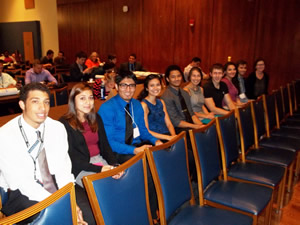
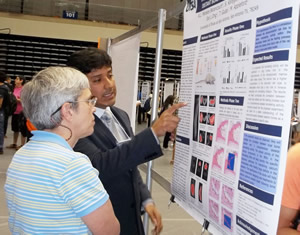
The first RISE/MARC Research Symposium took place in Fall 2004 in the Loeffler room of the Biosciences Building. The success of this event led program staff to make it an annual event, and even experiment with hosting a symposium each semester. During the symposia, RISE and MARC students gave poster and oral presentations. They presented research which they performed at The University of Texas at San Antonio, UT Health San Antonio, and various institutions around the country.
RISE UG Awards Celebrations
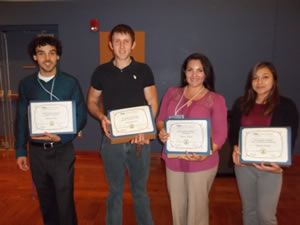
And finally...each Spring and Fall, we hosted an awards ceremony. Here we both honored our graduates and celebrated the end of the semester. Students from all levels participated and got to know one another while playing games and eating. Program staff and students celebrated our newest graduates.