Posted on October 2, 2026 by College of Sciences
#FacultySpotlight
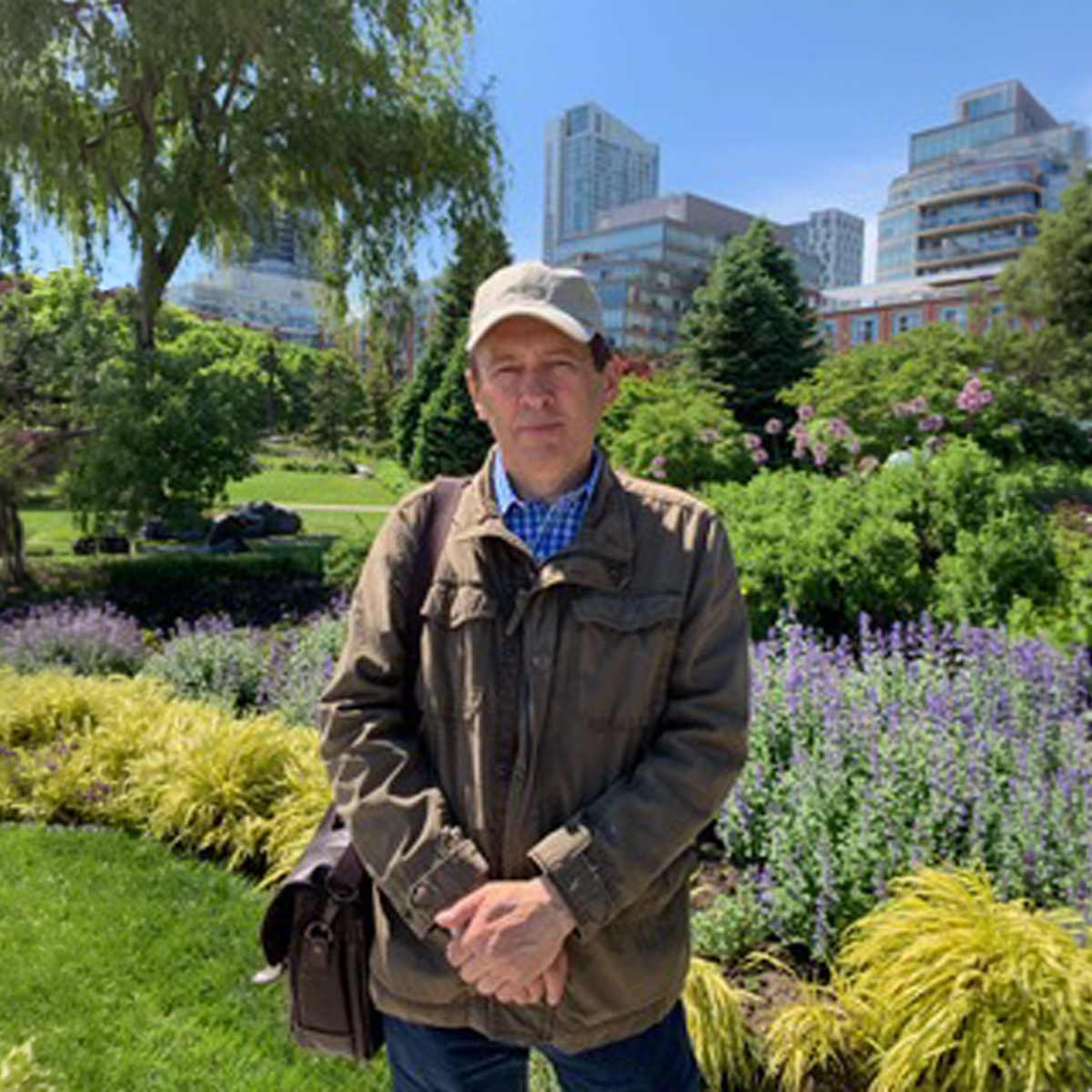
Gelu Popescu, Ph.D., Department of Mathematics
What did your journey to UT San Antonio look like and are you fixed-term track or tenure track?
I came at The University of Texas at San Antonio as Assistant Professor in the Department of Mathematics in 1994. I was promoted to Associate Professor with tenure in 1997, and to Full Professor in 2000. In 2004, I was the recipient of the President's Distinguished Achievement Award for Research and, in 2018, I was inducted into The Academy of Distinguished Researchers in recognition of the impact and the overall quality of my research, publications in highly regarded and leading journals in mathematics, as well the NSF research grants I have received as principal investigator for more than 20 years.
What do you enjoy most about your area of study?
The theory of operators can be traced back to work of Fredholm and Hilbert on integral equations in the late 19th and early 20th centuries. It grew considerably in scope and importance due to the discovery of quantum mechanics by Heisenberg and Schrodinger. The arrival of quantum mechanics, in 1925, introduced von Neumann into a field of mathematical investigation, operator theory, in which he achieved some of his most prominent successes. His work on the mathematical foundations of quantum mechanics culminated with the spectral theorem for normal operators in 1929. My research interests include functional analysis, operator theory and operator algebras, noncommutative harmonic analysis and interpolation.
What I enjoy the most in my area of research is the interplay between operator theory, harmonic analysis, noncommutative function theory, and operator algebras, as well as their applications. In recent years, the noncommutative multivariable operator theory has witnessed an explosive development with applications in free probability, quantum computing and quantum information theory, electrical and mechanical engineering, control theory and optimization, and image processing.
What are some of the most notable research projects that you've been involved in?
Since I came to The University of Texas at San Antonio, I have published over 100 papers in top journal of mathematics such as Advances in Mathematics, Journal of Functional Analysis, Journal fur die Reine und Angewandte Mathematik, Mathematishe Annalen, Journal of Operator Theory, Proceedings of the Royal Society of Edinburg, Journal of Mathematical Analysis and Applications, Transactions of the American Mathematical Society, Proceedings of the London Mathematical Society, etc.
I also published three memoirs through the Memoirs of the American Mathematical Society:
- Entropy and Multivariable Interpolation, 2006, 83pp.
- Unitary Invariants in Multivariable Operator Theory, 2009, 124 pp.
- Operator Theory on Noncommutative Domains, 2010, 91 pp.
Recently, my monograph on Noncommutative Multivariable Operator Theory was published in the American Mathematical Society book series Mathematical Surveys and Monographs, Volume: 297; 2026; 643 pp.
The purpose of the monograph is to introduce the reader to a free noncommutative analogue of the celebrated Sz.-Nagy–Foias theory of contractions (on Hilbert spaces) in the closed unit ball of B(H)n, where B(H) is the algebra of bounded linear operators on a Hilbert space H. The elements of this noncommutative ball are called row contractions.
This book contains results about the unit ball of B(H)n and classes of noncommutative varieties, which are derived from the isometric dilation theory of row contractions, the study of the associated universal algebras and functional calculus, the noncommutative commutant lifting theorem and interpolation, the characteristic function and operator model theory on Fock spaces, and the theory of free holomorphic (resp. pluriharmonic) functions on the unit ball of B(H)n. Over the years, the theory of row contractions has had profound implications in function theory and interpolation in Cn, prediction theory and entropy optimization, scattering and multivariable linear system theory, free semigroup (resp. semigroupoid, graph) algebras and the isomorphism problem, the study of endomorphisms of B(H), states on Cuntz algebras and wavelet analysis, commutative multivariable operator theory, tensor algebras over C*-correspondences, noncommutative function theory, etc.
The book is intended for graduate students and researchers in mathematics, engineering, and physical sciences, who are interested in exploring the interaction between multivariable operator theory, operator algebras, harmonic analysis on Fock spaces, and noncommutative function theory, as well as in their applications. The book is essentially self-contained and accessible to any reader who has had a course in functional analysis that includes an introduction to operator theory and C*-algebras.
I should mention that the research for this work was partially supported by the National Science Foundation and by The University of Texas at San Antonio (several FDLs).
For more information on the book, we refer to https://bookstore.ams.org/SURV/297.
What is your proudest moment with the COS?
I am proud of the impact I have had on numerous students willing to discover the beauty of mathematics and who, eventually, got a PhD in Mathematics (UT San Antonio does not have one) at other prestigious universities.
I am very proud of my contributions to the development of the dilation-theoretic approach in noncommutative multivariable operator theory which was embraced and pushed further by several brilliant mathematicians and has now a well-defined place in operator theory and has led to several applications.
I am also proud that my work is frequently cited by world-renowned mathematicians including Fields medalists, and that I have represented UT San Antonio, as invited speaker, at many prestigious international conferences in operator theory and operator algebras, which enhanced the visibility of the university in the world.
What do you enjoy most about your job?
I love doing research in mathematics and enjoy teaching my students, with the hope that some of them will benefit from it and become teachers or researchers in mathematics or sciences. There is nothing more rewarding than doing what you love the most.
How would you spend your ideal Saturday?
My ideal Saturday would be spent with my family.
What are your book recommendations?
- 1984 by George Orwell
- One Hundred Years of Solitude by Gabriel Garcia Marquez
— College of Sciences
Explore the Mathematics Department!
Dedicated to research, high-quality instruction, and community engagement that embraces excellence by empowering its undergraduate and graduate students, especially those from backgrounds underrepresented in the mathematical sciences.
Recent Mathematics Spotlights
View More Spotlights