Posted on February 27, 2026 by College of Sciences
#ThisIsWhatAScientistLooksLike

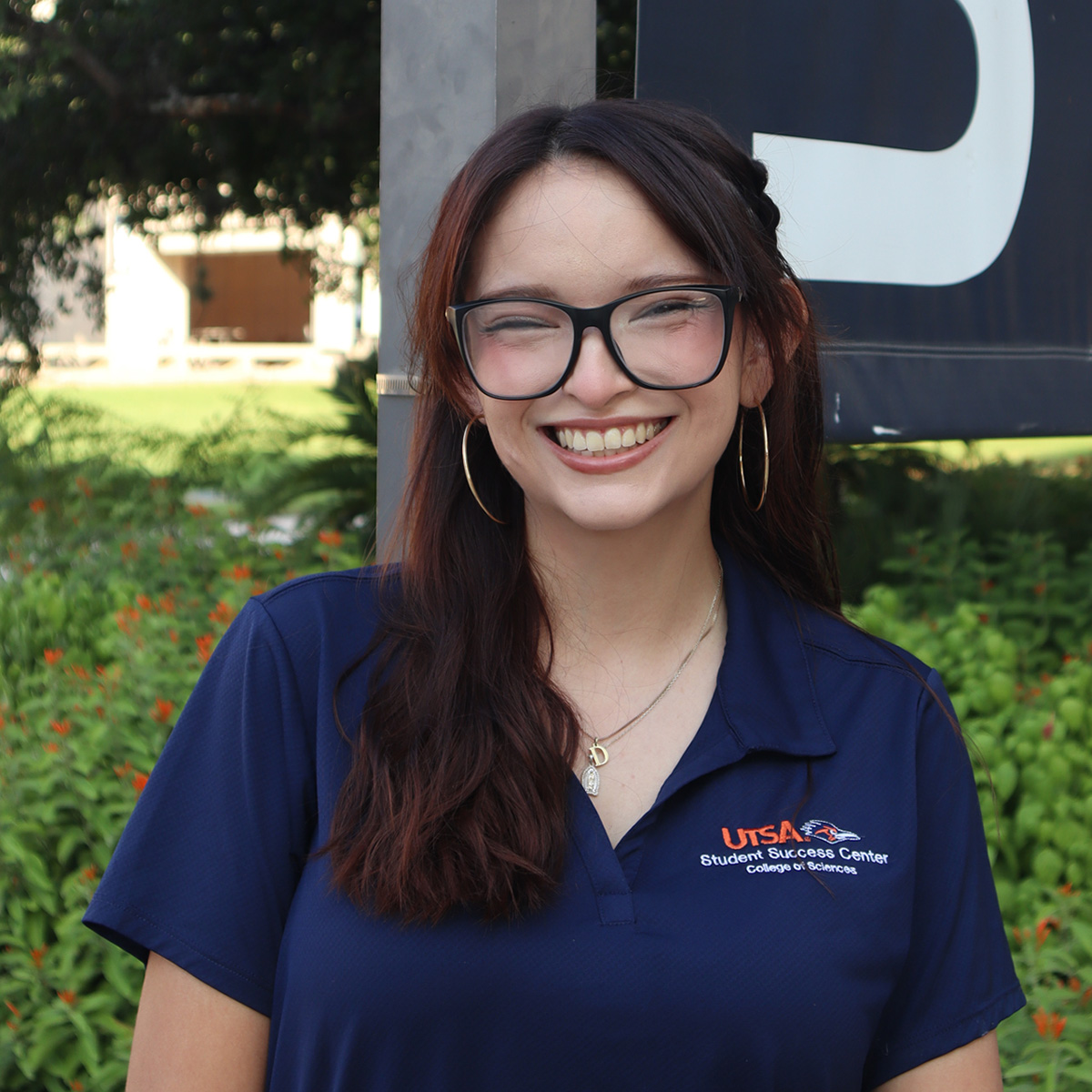
Mariel Ortega, Environmental Science M.S. Student
By Ryan Schoensee, Senior Communications Specialist
Mariel Ortega's fascination with birds began at a young age, during a summer break in between elementary and middle school. While spending time outside, she stumbled upon a woodpecker's nest and was immediately captivated. From that moment on, she fell irrevocably in love with birds and with observing them in their natural habitat.
Many years later, as an undergraduate, Mariel discovered that birds can serve as bioindicators for their environments. By tracking their behavior and wellbeing, scientists can better understand the overall health of an ecosystem. This realization led her to studying environmental science.
Now, as a graduate student pursuing her M.S. in Environmental Science at UT San Antonio, Mariel is turning her lifelong interest into research that bridges ecology, anthropology, and conservation.
Mariel's journey to UT San Antonio began with an opportunity to work as a graduate research assistant on the Urban Bird Project, a transdisciplinary environmental initiative that studies local, migratory, and culturally significant birds.
"The Urban Bird Project is an interdisciplinary endeavor that looks at birds through the lens of several disciplines," said Mariel. "This was really attractive to me because I have an interest in both the natural and social sciences."
Since becoming a Roadrunner, Mariel has presented her research at major conferences, including meetings hosted by the Association of Field Ornithologists and the American Ornithological Society. She has also shared science communication presentations at UT San Antonio and with local organizations such as the Bexar Audubon Society. Her research was further recently featured in the Winter 2025 issue of the Audubon online and print magazine. For Mariel, connecting people to science is as important as conducting the research itself.
Today, her master's thesis continues that mission. Working with the Urban Bird Project and under the guidance of faculty collaborator Jennifer Smith at Texas A&M University-Kingsville, Mariel studies how plastic pollution affects birds. By analyzing materials found in bird droppings and vacated nests, her research explores whether birds can serve as indicators of environmental plastic contamination.
Along the way, Mariel has already had extraordinary field experiences, including one unforgettable internship.
"One of my favorite experiences was an internship with the Cornell Lab of Ornithology's Macaulay Library. I went with a small team to record birdsong in Australia. For two weeks we camped in the Western Australian Outback, and each day was filled with jaw-droppingly gorgeous birds," Mariel said.
"I learned the hard way how easy it is to get lost in the Outback, but thankfully I was within yelling distance and now I have the ultimate party story about how I almost died in Australia," she added lightheartedly.
Outside the lab, Mariel enjoys creative writing, practices capoeira, and studies Korean. She is also a frequent contributor to writing stories for the Catalyst, the College of Sciences' official magazine publication.
After graduation, she hopes to continue her research abroad. She has applied for a Fulbright opportunity in Seoul, South Korea, where she would study how human noise affects birdsong and how those changes influence people's awareness of birds.
Ultimately, Mariel's goal is to become a professor of ornithology, combining research with mentorship.
"Many professors have provided invaluable help in getting me where I am today," she said. "I hope to pay it forward as a professor myself."
Her advice to future students is simple, "College is what you make of it. Opportunities exist, but you have to take the initiative to seize them."
For Mariel Ortega, seizing those opportunities has already taken her from a childhood bird sighting all the way to the Australian outback—and her journey is just getting started.
— College of Sciences
Explore the BHE Department!
Designed for students who want a focus in biological structures and systems from multicellular life to local ecosystems to the entire terrestrial biosphere. Students have access to strong research programs, state-of-the-art resources, and competitive financial support.
Recent BHE Spotlights
View More Spotlights