Cellular Biophysics and Optical Imaging Instruments
- Spectrophotometer for hemolysis assays.
- Microfluidic system for cellular video-assays.
- Stopped flow spectroscopy for cellular assays and protein interactions.
- Quench flow for membrane transport characteristics.
- Stable isotope ratio analyzer.
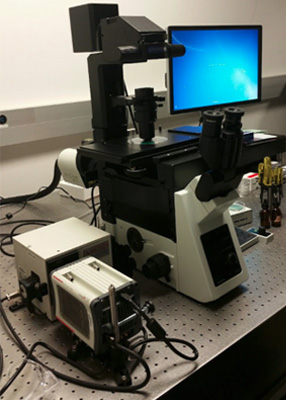
- Olympus IX73 microscope with halogen and LED lamps and 532 and 655 nm diode lasers: brightfield, darkfield, fluorescence, TIRF, Acton SpectraPro grating spectrometer for imaging spectroscopy, Hamamatsu ImagEM X2 EMCCD camera.
- Biotek Synergy HTX microplate reader with absorption, fluorescence, and luminescence readout modalities. Includes wavelength range from 200–999 nm and temperature and shaking control.
- Countess II automatic cell counter.
Preparatory/Analytical Instruments
- Becker 50000 RPM ultra-centrifuge.
- Small benchtop instruments (sonicators, vortex, hot stirring plates, rotovaps).
Optical Spectroscopy Instruments
- UV-Visible spectrophotometer.
- Steady-state fluorometer.
- Spectrometer for fluorescence and fluorescence anisotropy decay.
- Raman spectrometer.
- Circular Dichroism spectrometer.
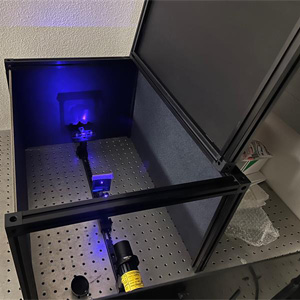
- Benchtop laser irradiation system.
- Ocean Optics UV Vis spectrometer.
- Optical Parametric Oscillator (Ekspla, NT342B) tunable laser from 400–2600nm.
- Maestro energy meter with calibrated detector and attenuator.
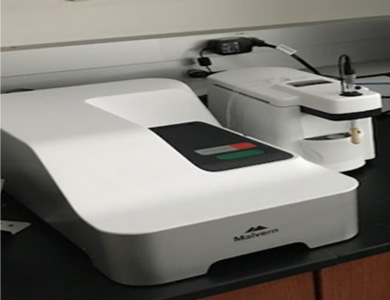
- Dynamic Light Scattering System (Malvern Instruments, Zetasizer, Ultra).
- Ocean Optics, USB 2000+UV-VIS-ES controlled by computer through LabVIEW.
- Horiba, iHR 320 four ports with digitally controlled slits, tungsten halogen lamp, sample compartment for absorption, reflection and transmission measurements, TE cooled PMT, PMT, Open Electrode CCS.
- Photoacoustic spectroscopy (custom 4 quadrant detector for all optical photoacoustic spectroscopy and PZT transducer).
Computing Resources
- Dell CPU cluster (aggregate disk space: 248 TB; CPU cores: 364; Memory: 1.2 TB; including 4 RTX 6000, 4 A6000 GPUs etc. FP32: 0.323 peta FLOPs).
- GPU server (7 Nvidia Tesla C2070, 444 processors each one, 12 CPU cores).
- Mac Pro cluster (44 CPU cores).
- 48 TB NAS storage and backup system.
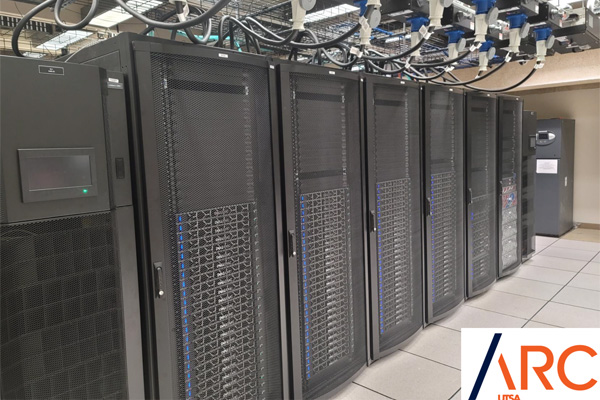
- UT San Antonio's high-performance computing cluster ARC.
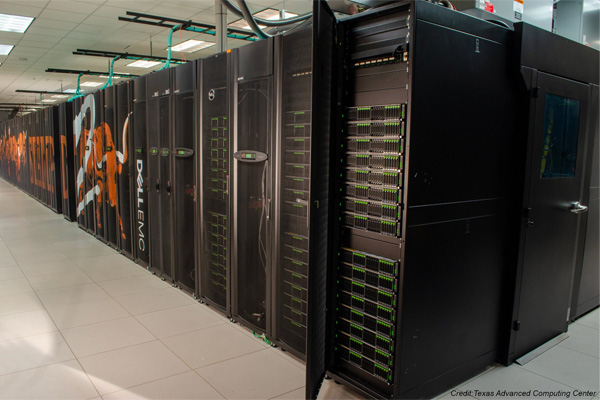
- Texas Advanced Computing Center (TACC).