
Quantum Foundations
Drs. Eduardo Dueñez and Jose Iovino
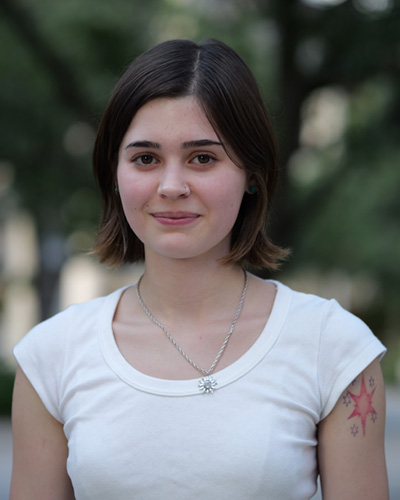
Olivia Aubone
I am working with Drs. Dueñez and Iovino on the development of a model theory of quantum-valued structures. One of our goals is to obtain new results in quantum foundations and in quantum complexity theory.
Post Quantum Cryptography
Dr. Henry Chimal-Dzul
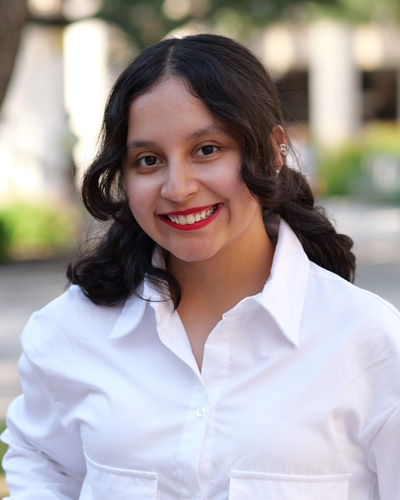
Sofía Carranza
I am a graduate student at the Department of Mathematics at UT San Antonio. My research, under the direction of Dr. Henry Chimal-Dzul, focuses on studying the Linear Equivalence Problem—a core hardness assumption underlying several code-based signature schemes currently under evaluation in the NIST PQC standardization process. In this problem, one is given two matrices that generate vector spaces with prescribed structural properties, and the task is to recover the linear transformations that map one space to the other. My goal is to develop and analyze new strategies to attack this problem, including approaches using machine learning techniques. With this approach we are seeking to strengthening or discovering weaknesses on the security of some code-based cryptosystem.
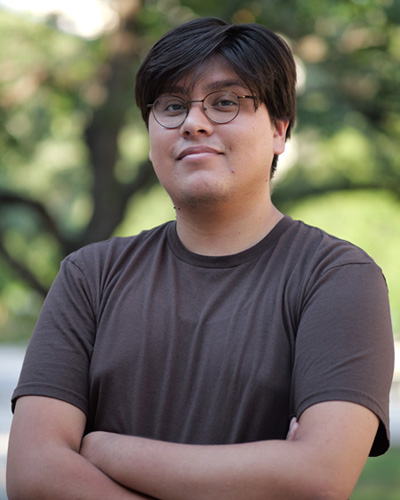
Angelo Lomeli
My research, conducted under the direction of Dr. Chimal-Dzul and in collaboration with researchers at Fujitsu Research of America, lies in code-based cryptography, a subfield of post-quantum cryptography. In particular, I study algebraic constructions of Quasi-Twisted (QT) codes using polynomial matrices, Gröbner basis techniques, and module theory. My work aims to develop a general framework for constructing QT codes with prescribed dimension and minimum Hamming distance—key parameters for modeling the performance and evaluating the security of a recently proposed code-based cryptosystem built upon such codes.
Quantum Information
Dr. José Morales
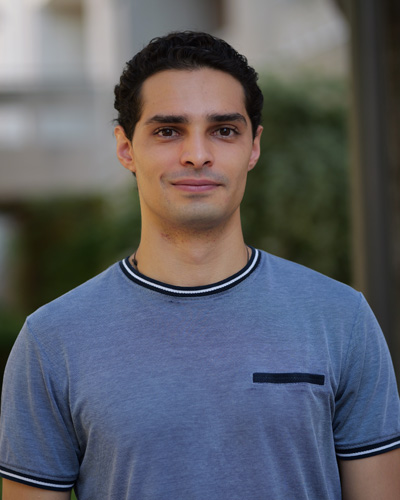
Mariano Alcalde
I collaborate with Professor José Morales on the theory of open quantum systems with environmental memory (non-Markovian dynamics). I use master-equation and phase-space methods, supported by numerical simulations, to study decoherence and information flow. I have also developed nanophotonics simulations for quantum optics and theoretical AMO models of collective light–matter interactions for applications in quantum information and thermodynamics. I am also interested in the foundations of quantum mechanics and the philosophy of physics.
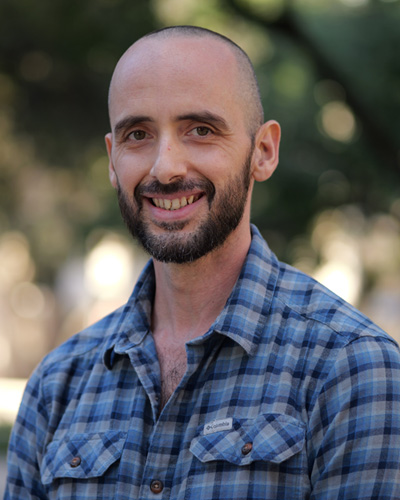
Brandon Lippe
I work with Dr. José Morales studying the Wigner formulation of open quantum systems and quantum algorithms for Stochastic Gradient Descent (SGD). We study the continuous time limit of the SGD algorithm and how it relates to the Wigner-Fokker-Planck equation for modelling quantum transport under Markovian noise. More broadly, my work focuses on finding or developing newer mathematical models/algorithms and applying them to physics problems.
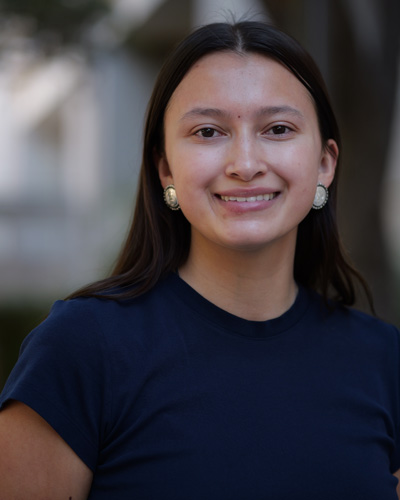
Avery Tovar
My research focus is on open quantum systems, with an emphasis on the Wigner-Fokker-Planck (WFP) equation. I am developing a Monte Carlo solver that models the time evolution of quantum systems interacting with their environment. In this project, I transform the WFP into its stochastic differential form and integrate it using the Euler-Maruyama method, incorporating drift and diffusion terms, as well as a tunable friction parameter.
Mathematical Quantum Field Theory
Dr. Stephen Peña
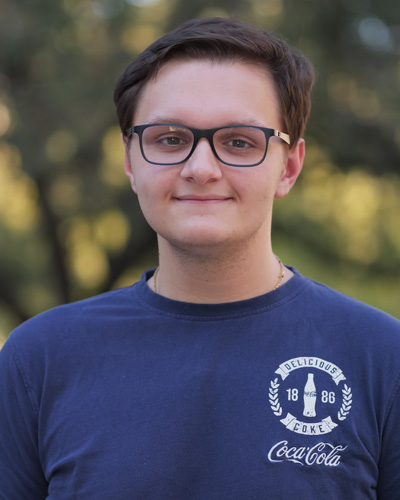
Collin Sunes
I am a graduate student in the Department of Physics and Astronomy at UT San Antonio. My research with Dr. Stephen Peña focuses on the mathematical foundations of quantum theory, particularly within the framework of gauge field theory. I am interested in how geometry and symmetry principles underlie the structure of physical laws, and how gauge invariance provides a unifying language between classical and quantum descriptions. My work explores the mathematical consistency of gauge fields and their quantization, as well as connections between field theory, topology, and operator algebras. This research reflects my broader goal of understanding the deep correspondence between mathematics and physics, particularly in the realm of quantum field theory.
