
Posted on August 27, 2026 by College of Sciences
#CollegeNews
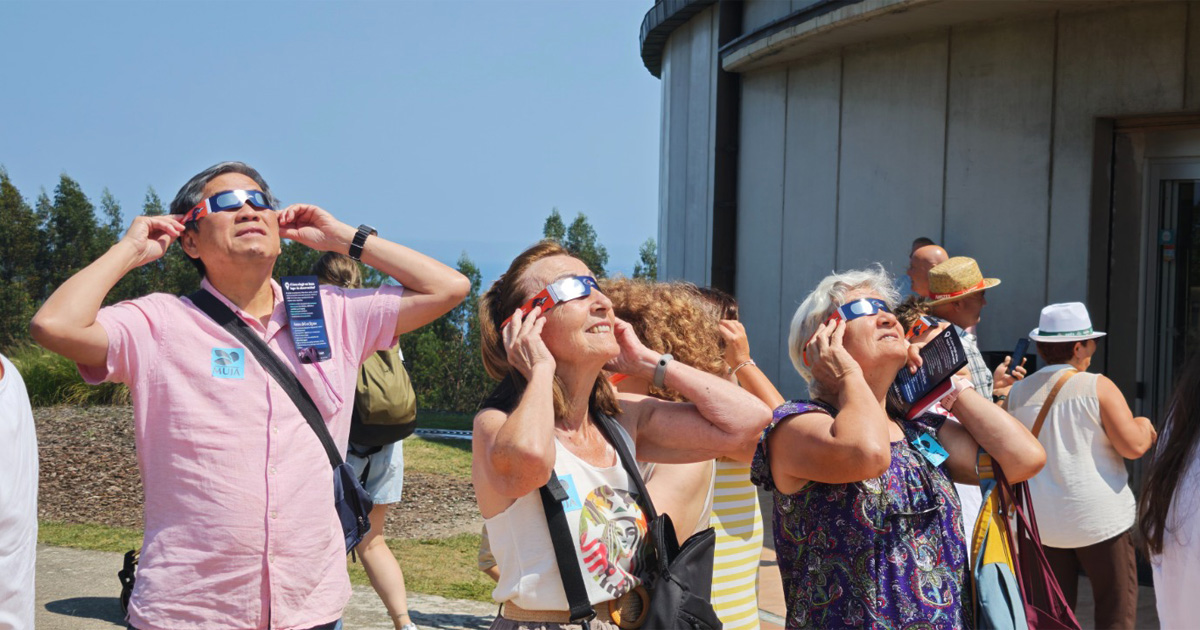
People gathered near the Jurassic Museum in Colunga, Spain to view the eclipse
UT San Antonio Faculty Follow Eclipses Across the Atlantic
By Lindsay Fuller
Faculty members donated more than 6,000 surplus eclipse glasses to organizations in Spain and England before traveling overseas to view the 2026 total solar eclipse.
In October 2023 and April 2024, San Antonio, Texas, fell within the paths of annularity and totality for two of the most widely anticipated astronomical events in recent U.S. history. For the 2023 annular eclipse, many Texas residents saw perfect conditions and a stunning celestial display. However, in 2024, clouds covered much of San Antonio and the Texas path of totality, limiting views of the eclipse for many spectators.
For both experiences, the UT San Antonio Department of Physics and Astronomy was prepared with more than enough eclipse glasses to hand out to the student body, some San Antonio schools, and surrounding communities. After the two events, the department was left with an excess several thousand pairs of solar viewers and no more eclipses to watch in Texas anytime soon.
That surplus proved unexpectedly useful on August 12, 2026, when another solar eclipse passed over Greenland, Iceland, and Spain while the UK saw up to 96% coverage.
Department of Physics and Astronomy faculty members Angela Speck, PhD, professor, and Lindsay Fuller, PhD, assistant professor of instruction, reached out to some of their fellow astronomy colleagues in Spain and England offering to donate these surplus glasses. Together, they helped coordinate the donation of more than 6,000 pairs to the National Space Centre in England, the European Space Agency in Madrid, and the Universidad de Oviedo, which partnered with Allande Stars, a project that brings astronomy to rural villages in southwestern Asturias, Spain.
Naturally, the faculty members didn't stop at donating eclipse glasses, they went to see the eclipse for themselves.
Speck chose Oviedo as her viewing location but, unfortunately, encountered clouds once again. Fuller traveled to Bilbao, where she saw only about 30 seconds of totality but enjoyed excellent viewing conditions. Nearby in Palencia, former UT San Antonio postdoctoral fellow Enrique Lopez-Rodriguez, PhD, participated in an official eclipse event hosted by the Instituto de Astrofísica de Canarias (IAC), where skies were also clear.
The next major eclipse will pass from the Mediterranean Sea through southern Spain, Gibraltar, Morocco, Algeria, Tunisia, Egypt, Saudi Arabia, Yemen, and Somalia with a totality of over six minutes in some locations.
Faculty and staff may want to start planning those future vacations now!
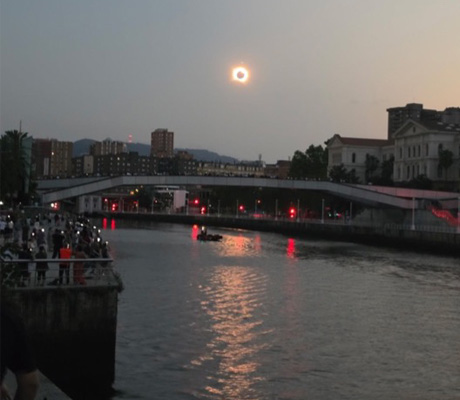
Eclipse viewing in Bilbao, Spain
— College of Sciences
